
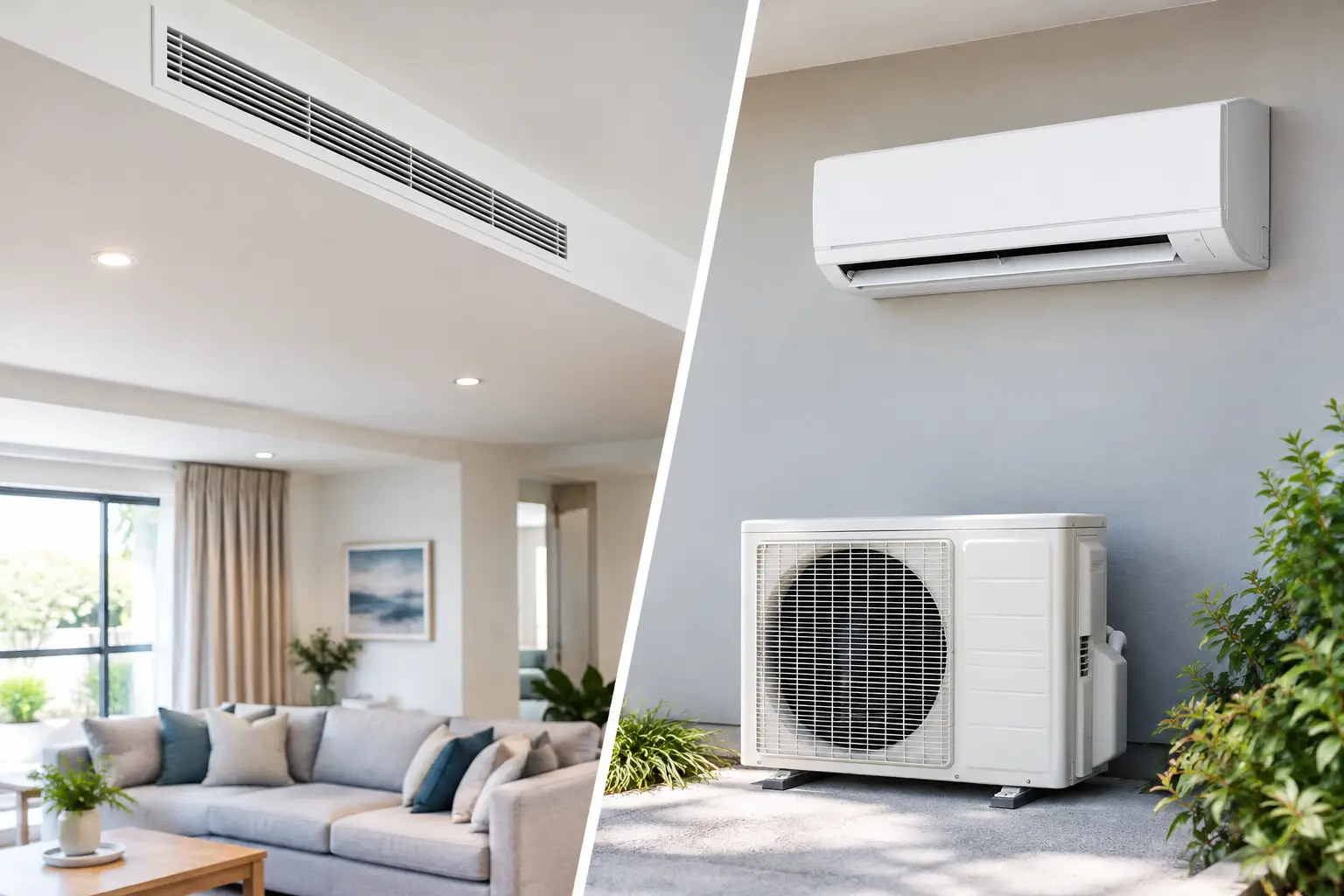
A hot afternoon can quickly reveal where a home’s comfort falls short: the living room is cool, the back bedroom is stuffy, and someone is standing beneath a wall unit trying to feel the airflow. When weighing up ducted cooling versus splits, the best choice is rarely about which system is simply better. It is about how you live, the layout of your property, your budget and the level of control you want room to room.
For Melbourne, Geelong and other Victorian homes, both systems can provide reliable, energy-efficient comfort when they are correctly selected and professionally installed. The key is matching the system to the space, rather than expecting one unit to solve every heating and cooling challenge.
Ducted cooling versus splits: the key difference
A ducted air conditioning system uses a central indoor unit, concealed ducts and ceiling or floor outlets to distribute conditioned air throughout multiple rooms. It is designed as a whole-home solution, with controls that can be placed in a convenient central location or managed through compatible smart controls.
A split system has two main components: an indoor wall-mounted unit and an outdoor condenser. One split system generally conditions one room or an open-plan zone, although multi-split systems can connect several indoor units to one outdoor unit.
That difference affects almost every part of the decision, from upfront cost and visual appearance to daily running habits. Ducted cooling provides a more integrated solution for larger areas, while splits are often a practical, cost-effective answer for one or two priority spaces.
Comfort across the whole home
Ducted cooling is often the stronger choice for families who want consistent comfort across bedrooms, living areas and shared spaces. Rather than cooling only the room where the indoor unit is installed, the system can be designed around the home’s floor plan, window exposure, insulation and occupancy.
This matters in multi-bedroom homes. A split system in the living room may make the main area comfortable, but it cannot reliably cool closed bedrooms down the hallway. Adding individual units can solve that issue, although each room then needs its own indoor unit, controls and installation work.
With ducted cooling, air is delivered through discreet outlets and can be balanced during installation to suit different rooms. The result can feel less intrusive than relying on high airflow from a single wall-mounted unit to reach adjoining areas.
That said, a split system can be exceptionally effective in the right setting. For an apartment, a compact home office, a single living area or a rarely used guest room, a correctly sized split can cool the space quickly and efficiently without paying for a whole-home system.
Zoning can make ducted systems more efficient
One common concern about ducted cooling is that it must cost more to run because it services the entire home. That can be true if every room is cooled unnecessarily. It does not need to be the case with a well-designed zoned system.
Zoning divides the home into separate areas, such as living spaces, bedrooms or an upstairs level. You can cool the areas in use while leaving other zones off or set to a higher temperature. For example, a family may cool the living zone in the afternoon, then switch to the bedroom zone at night.
Smart controls add another layer of convenience. Depending on the system design, they can support scheduled operation, temperature adjustments and more considered use of each zone. This helps reduce the temptation to run the entire system at full capacity when only part of the home needs attention.
Splits offer room-by-room control by nature. If you only cool one room at a time, that can be very economical. The trade-off appears when several units run together. At that point, energy use, outdoor unit capacity and the convenience of managing multiple remotes deserve careful consideration.
Upfront cost and long-term value
A split system usually has a lower initial cost than a ducted installation. It requires less equipment, less installation time and no network of ducts through the ceiling or under the floor. For targeted cooling, this makes it a sensible option.
Ducted cooling is a larger investment because the system must be designed for the property. Costs can vary based on the number of outlets, zones, access to roof space, electrical requirements, unit capacity and whether the home is being built, renovated or retrofitted.
For a new build or major renovation, installing ducted air conditioning can be particularly worthwhile because ducts and outlets can be incorporated while ceilings and walls are accessible. Retrofitting is also possible in many homes, but roof access, ceiling space and the building layout need to be assessed first.
Long-term value is not only about the purchase price. Consider how long you plan to stay in the home, whether you want heating as well as cooling, how many rooms need regular conditioning and whether a discreet, integrated system matters to you. A tailored quote should explain the practical choices rather than push a one-size-fits-all answer.
Appearance, noise and available space
For many homeowners, aesthetics are a major reason to choose ducted cooling. Most of the equipment is hidden, with only the outlets and return-air grille visible inside. There are no wall-mounted heads in bedrooms or living areas, which can make a difference in carefully designed interiors and renovations.
Split systems are more visible, but modern units are compact and can be positioned to minimise their impact. They are often the easier choice where there is limited ceiling space or where only one part of the home needs climate control.
Both system types have an outdoor unit, so placement should be considered carefully. A professional installer will assess airflow, service access, noise, drainage and the distance between indoor and outdoor components. Poor placement can affect performance and make future maintenance more difficult.
Noise should also be assessed in context. A quality split system can be very quiet indoors, while ducted systems keep much of the operating equipment out of living spaces. Correct sizing, installation and servicing all play a part in keeping either system running smoothly.
Heating needs may change the decision
Many reverse-cycle split and ducted systems provide both cooling and heating. This can simplify your home comfort setup, especially in Victoria where a warm, dry home is just as valuable as cool relief in summer.
If you currently use a mixture of portable heaters, older gas heating and fans, a reverse-cycle ducted system may offer a more cohesive whole-home solution. If you only need reliable heating and cooling in a living room and main bedroom, two well-selected split systems may be enough.
The right capacity is critical. An oversized system may cycle inefficiently and create uncomfortable temperature swings. An undersized system can run constantly without delivering the comfort you expect. Room size is only one factor. Ceiling height, glazing, insulation, orientation and heat-generating appliances all need to be considered.
Which system is right for your property?
Ducted cooling is often suited to larger homes, families using several rooms each day, renovations and owners who prefer a clean, integrated finish. It is also a strong option where zoning and smart temperature management can reduce unnecessary operation.
Splits are often ideal for smaller homes, apartments, individual rooms, home offices and properties where budget or building constraints make ducting impractical. They can also be a sensible staged approach, allowing you to add comfort where it is needed most.
There is also a middle ground. Some households use ducted air conditioning for the main home and a separate split for an extension, a converted garage or a room with unusual usage patterns. This can work well when the design is planned carefully rather than added piece by piece.
Start with a professional assessment
The most dependable way to compare ducted cooling versus splits is to have the property assessed by an experienced air conditioning professional. They can review your layout, roof space, electrical supply, preferred comfort zones and heating requirements, then recommend a system sized for real-world performance.
Air Con Solutions helps homeowners and light commercial customers choose, install and maintain systems that suit the way their spaces are used. Whether you need a focused solution for one room or a complete ducted design with smart zoning, the goal is the same: dependable comfort, sensible energy use and a system you can rely on when the temperature changes.